
No. 244Norse Traditions
Loki
Loki Laufeyjarson
Shape-shifting wit of the Norse myths, Odin's blood-brother and net-maker
In the Norse myths, Loki Laufeyjarson is a cunning shape-shifter and go-between of gods and giants. His father was the giant Fárbauti, yet he is counted among the Æsir without being one of them, and he is sworn blood-brother to Odin. He fathers Fenrir, Jörmungandr and Hel, and, as a mare, Sleipnir. He is also credited with the first fishing net. His cleverness sometimes rescues the gods and sometimes ruins them.
He has no fixed function, and no ancient cult of Loki is attested. He is known from the Poetic Edda and Snorri Sturluson's Prose Edda. Today some people called Lokeans honour him, many of them quietly, while many Heathens do not, so his place in modern practice is debated. Carvings that may show him survive, and a grinning 1765 Icelandic drawing shows him with his net.

The story behind the line on the shirts
“Made the net. Caught in it.”
It's from Snorri's Gylfaginning. Hiding from the angry gods, Loki spent his days as a salmon in a waterfall, and, wondering how they might catch him, he knotted the first fishing net. When they came, he threw it in the fire, but wise Kvasir read the net's pattern in the ashes, and the gods made one like it and caught him.
How to recognise Loki
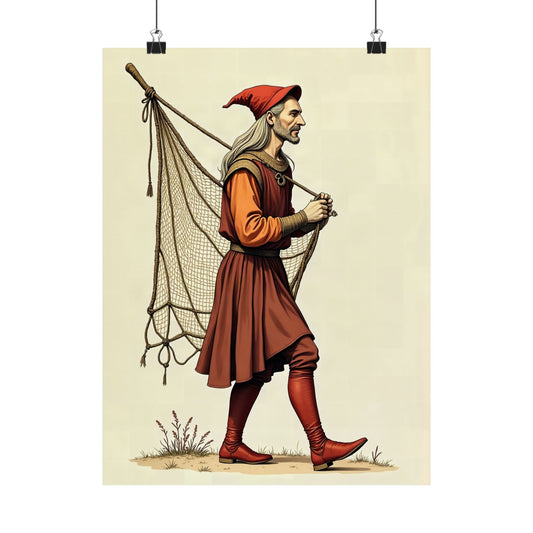
- The netA large fishing net of knotted linen twine with square mesh hangs behind him; in Snorri's telling he first knotted it while hiding from the gods, and it is his clearest sign.
- Grinning, knowing faceLook for a broad grin, long nose, moustache and short pointed beard, the face of an alert, amused, quick-witted figure rather than a monster.
- Long fair hairHis hair falls loose down his back, as in the Icelandic manuscript drawing.
- Soft cap and wide collarThe 1765 artist dressed him in his own day's clothes: a soft red-brown cloth cap and a wide flared collar over a pleated tunic.
- Tunic, breeches and bootsA dark red-brown tunic, ochre sleeves and knee breeches, tall red boots and pale gloves show him mid-stride, turning as he walks.
- SalmonA small salmon beside him recalls the shape he took to hide in Fránangr's waterfall, the hiding that led him to knot the net.
Names and titles
- The Shape-ChangerA name for the many shapes he takes in the myths: salmon, mare and fly
- Blood-Brother of OdinHe and Odin swore an oath that made them blood-brothers, which is why the gods tolerated him
- Maker of the First NetIn Gylfaginning, Loki knots the first fishing net while hiding from the gods
- The Salmon in the FallsHe hid by day in Fránangr's waterfall in the shape of a salmon
- Laufey's SonHis mother's name, Laufey, gives him the by-name Loki Laufeyjarson
Feast days
Loki's Day1 April, every year
Loki's Day is a modern observance in which some Lokeans and Heathens honour Loki, the Eddic god, on April Fools' Day. No Norse source records a feast day for him, and the date draws on the trickery associated with him.
How it's celebrated. Observance is personal and varies. Some households mark the day with a feast and offerings to Loki, and Lokeans commonly describe offerings such as coffee, whiskey, cinnamon, chocolate or toys. Many treat the day as lighthearted. Others honour him at the late-summer rising of Sirius (Lokabrenna) or on a date that is personally meaningful.
Sources: Lokean Welcoming Committee: Does Loki have an official feast day? · Gangleri's Grove: A Feast-Day For Loki · The Wild Hunt: The Lokean Community
In art and place public-domain and openly licensed images


Loki in the shop
-
Loki: Maker of the First Net — Garment-Dyed One-Ink Tee
Vintage styleRegular price From $34.00 USDRegular price -
Loki: The Shape-Changer — Art Print
Painted portraitRegular price From $29.00 USDRegular price


Sources
- Britannica: Loki
- Britannica: Germanic religion and mythology (Loki)
- Wikipedia: Loki
- National Museum of Denmark: The Viking gods
- World History Encyclopedia: Loki
- MyNDIR (University of Victoria): SÁM 66, folio 79r
- Wikimedia Commons: SÁM 66, 79r, Loki
- The Viking Herald: Loki, central in myth, absent from cult
- Wikipedia: Sigyn
- Wikipedia: Kvasir
- Norse Mythology for Smart People: Loki Bound
- World Tree Project: document 2861
- The Wild Hunt: Loki in the White House
- Norroena Society: Loki Is Not a Heathen God
- The Wild Hunt: The Lokean Community, What We Really Look Like
- ADL: Valknot
- Wikipedia: List of symbols designated by the ADL as hate symbols
- ADL: Othala Rune
- Refinery29: April Fools' prank and spiritual meaning
- Humanistic Heathenry: Lokabrenna
- New World Encyclopedia: Loki
- Wikipedia: Poetic Edda
- Britain Express: Gosforth Cross
- Cumbria County History Trust: The Bound Devil
- Wikipedia: Icelandic Manuscript SÁM 66
- Snorri Sturluson, Prose Edda (trans. Anthony Faulkes)
- The Poetic Edda (trans. Carolyne Larrington)
- Wikipedia: Heathenry (new religious movement)
- The Wild Hunt: Pagan Community Notes, Loki ban rescinded
Also in Norse Traditions


← The Encyclopedia Spotted something to correct? Suggest a correction