
No. 245Greek Traditions
Medusa
Μέδουσα
The Gorgon whose calm, watchful face guards shields and temples
Medusa (Μέδουσα, Médousa, "guardian, protectress") is the one mortal among the three Gorgon sisters of Greek myth. Hesiod, around 700 BCE, names her as the mother of Pegasus and Chrysaor by Poseidon. In Ovid's later Roman version, she is a maiden famed for her hair, wronged in Athena's temple and then punished for it.
She is known above all from story and art rather than from a cult of her own. Her face, the gorgoneion, stood as a guardian on Athena's aegis, on shields and on temple walls. Today many people see in her a survivor who was blamed for what was done to her, and they wear her calm, watchful face as a sign of protection.

The story behind the line on the shirts
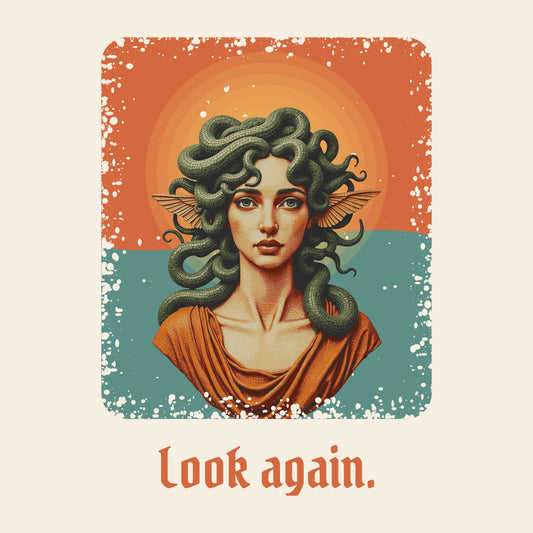
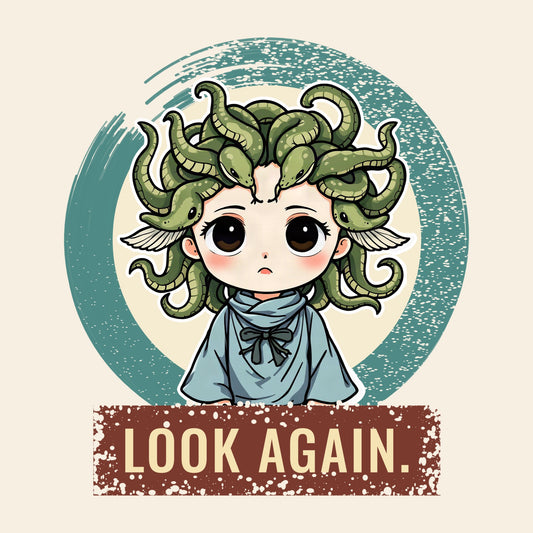
“Look again.”
Early Greek art made Medusa a frightening mask, but later Greek and Roman artists gave her a calm, beautiful, sorrowful face. In Ovid's Roman version she was wronged in Athena's temple, and she was the one punished. Today many people look again and see a survivor, not a monster. Her name even means 'guardian'.
How to recognise Medusa
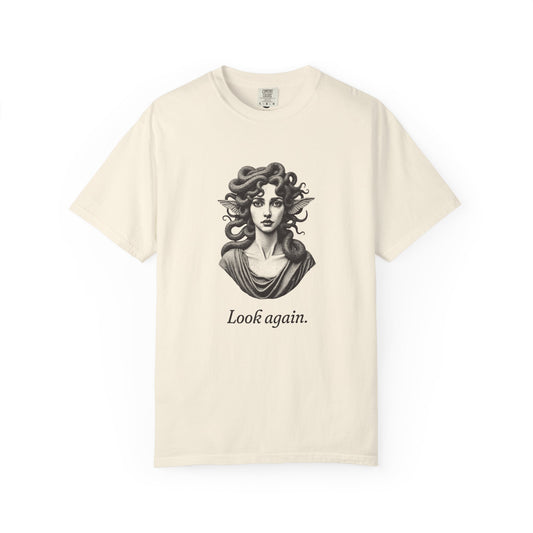
- A calm, human faceLook for the grave, melancholy face of a young woman, as in the Hellenistic and Classical 'beautiful Medusa' type shown by the Medusa Rondanini, a Roman marble copy of a lost Greek original; it is far from the fanged mask of earlier art.
- Living snakesSnake heads rise from her hair above the temples and their tails knot under the chin, marking her as a Gorgon and framing the cheeks.
- Small wingsA pair of wings springs from the hair above the brow or temples, drooping softly like the wings of a night bird, another sign that she is a Gorgon.
- An open, quiet gazeThe eyes are steady and gently sorrowful, never a glare; viewers have read the look of the Rondanini type in different ways, from pathos to cool stillness.
- Draped bustShe is shown as a bust with her shoulders covered by a simple draped chiton, whereas the ancient Rondanini is a head in high relief made to be set into architecture.
Names and titles
- The GuardianHer name Médousa means 'guardian, protectress'
- Fair-Cheeked MedusaPindar's 490 BCE phrase, an early sign that she could be seen as beautiful
- Mother of PegasusHesiod names her mother, by Poseidon, of the winged horse Pegasus and of Chrysaor
- The Watchful GorgoneionHer face guarded shields, Athena's aegis and temples as a protective emblem
- Survivor and GuardianA modern reading: many people see her as a survivor who was blamed for what was done to her, and as a protector
In art and place public-domain and openly licensed images


Medusa in the shop
-
Medusa · “Look again.” — Garment-Dyed One-Ink Tee
Vintage styleRegular price From $34.00 USDRegular price -
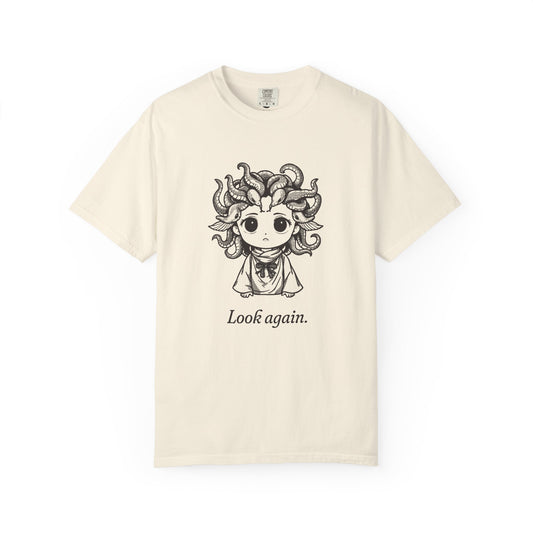
Medusa · “Look again.” — Garment-Dyed One-Ink Tee
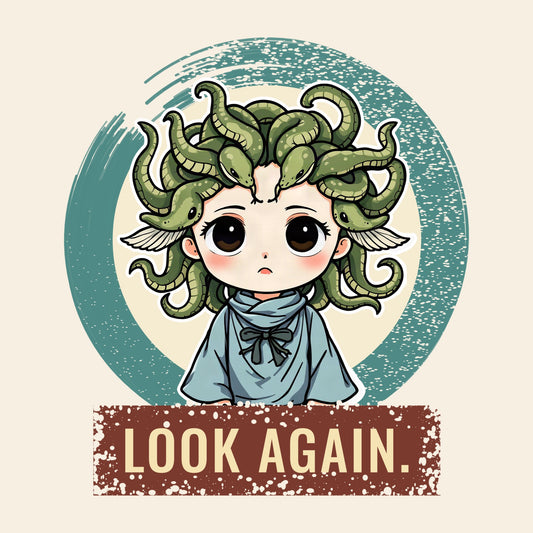
Cute styleRegular price From $34.00 USDRegular price -
Medusa · “Look again.” — Garment-Dyed Sweatshirt
Cute styleRegular price From $52.00 USDRegular price -
Medusa · “Look again.” — Garment-Dyed T-Shirt
Cute styleRegular price From $36.00 USDRegular price -
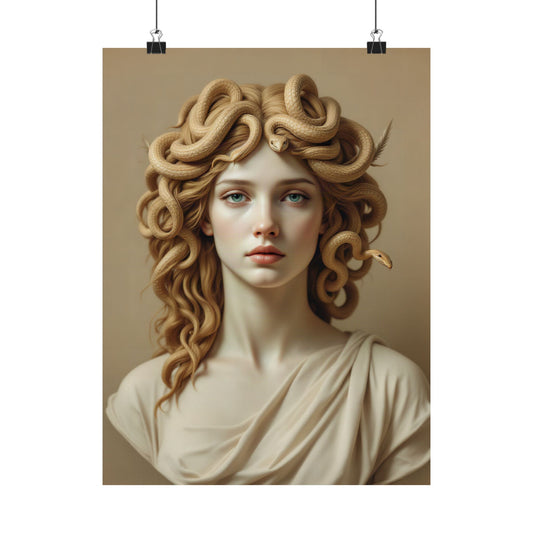
Medusa: Fair-Cheeked Medusa — Art Print
Painted portraitRegular price From $29.00 USDRegular price -
Medusa · “Look again.” — Unisex T-Shirt
Vintage styleRegular price From $29.00 USDRegular price -
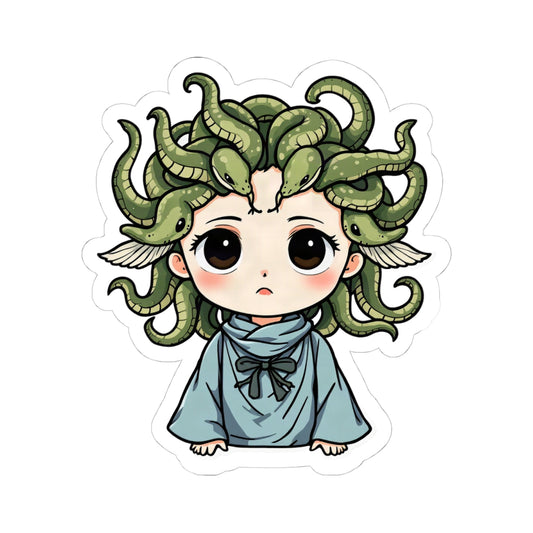
Medusa: Survivor and Guardian — Sticker
Cute styleRegular price From $4.50 USDRegular price -
Medusa · “Look again.” — Unisex T-Shirt
Cute styleRegular price From $29.00 USDRegular price








Sources
- Britannica: Medusa
- Britannica: Gorgon
- Wikipedia: Medusa
- Wikipedia: Medusa Rondanini
- Cosmo Wenman: The Medusa Rondanini Published
- Glyptothek catalogue text: Medusa Rondanini (ancientrome.ru)
- Vatican Museums: Gold appliqué with head of Medusa
- National Archaeological Museum, Athens: The Fatal Look of Medusa
- Theoi: Gorgones
- Perseus Digital Library: Ovid, Metamorphoses 4 (trans. Brookes More)
- Poetry in Translation: Ovid, Metamorphoses 4 (trans. A. S. Kline)
- Wikipedia: Gorgons
- Wikipedia: Winged Gorgoneion
- Theoi Gallery: Medusa by the Berlin Painter
- Theoi Gallery: Roman mosaic head of Medusa, Athens
- Scalar (USC): McDonough, Medusa in Ancient Greek Art
- Metropolitan Museum of Art: Medusa in Ancient Greek Art
- The Collector: Reclaiming Medusa
- RTÉ Brainstorm: Medusa and social media
- Wikipedia: Medusa with the Head of Perseus
- Wikipedia: Gianni Versace
- Wiener Museum of Decorative Arts: Medusa
- Wikimedia Commons: Versace Medusa emblem
- Britannica: Perseus
- EBSCO Research Starters: Medusa
- Perseus Digital Library: Hesiod, Theogony (trans. H. G. Evelyn-White)
- J. Paul Getty Museum: The Strozzi Medusa gem by Solon
Also in Greek Traditions


← The Encyclopedia Spotted something to correct? Suggest a correction