
No. 051Hinduism
Parvati
पार्वती
Daughter of the Mountain: gentle mother, steadfast devotee, and bride of Shiva
Parvati (पार्वती), the "Daughter of the Mountain", is the child of the Himalaya king Himavat and his queen Mena. Devotees believe she was reborn from Sati, Shiva's first wife, and won the meditating Shiva through long, patient austerity. In Kalidasa's poem Kumarasambhava she takes the name Aparna during her tapas. Together she and Shiva raised Ganesha and Skanda. She is also known as Uma, radiant Gauri and nourishing Annapurna.
Devotees turn to her for gentle motherhood, marriage and family life, devotion, steadfast resolve and daily food. Shaivas honour her as Shiva's consort and creative power. Shaktas honour her as a form of the Great Goddess, and some Shakta texts treat her as the Supreme Being herself. Smarta worshippers include Devi among the five deities of Panchayatana puja. Teej, Gauri Habba and Navaratri are kept in her name, and Chola temples worshipped her in bronze as bride, wife and mother.

The story behind the line on the shirts
“Ganesha gets it from her.”
Parvati is Ganesha's mother, and in the best-known story she made him herself, shaping a boy from the turmeric paste she bathed with (some tellings say clay) and setting him to guard her door. He wouldn't let even Shiva past. So his loyalty and stubborn resolve come straight from her.
How to recognise Parvati
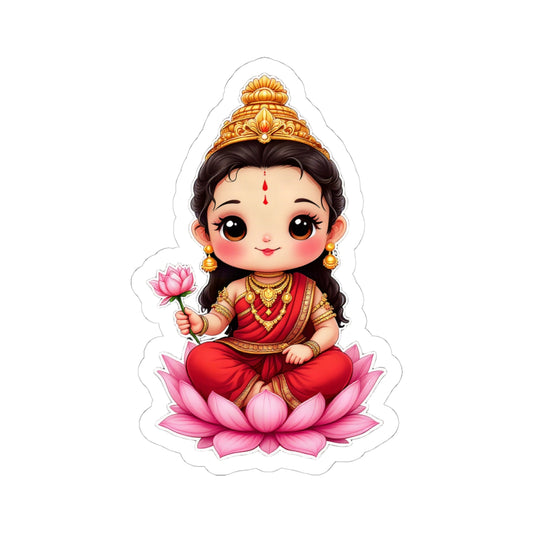
- LotusShe holds or offers a lotus or flower in one hand, which stands for purity.
- Abhaya gestureHer other hand may show abhaya, the "fear not" gesture of reassurance.
- Red sariShe wears a red sari, sometimes with a headband, as in devotional prints.
- Crown and jewelsA crown, necklaces, earrings, armlets, bangles and a bindi adorn her, and in Chola bronzes her crown matches Shiva's in style.
- Serene two-armed formAs the gentle consort she is youthful and calm, with two arms, seated on a lotus or a low throne; some solitary or Lalita forms have four or more arms.
- Fair, luminous faceGauri means "the fair" or "brilliant one", and she is shown beautiful and benevolent.
- Family at her sideShe may sit beside Shiva as Uma-Maheshvara on Mount Kailash, or with the child Ganesha, or with Shiva and the child Skanda in the Somaskanda form.
Names and titles
- Daughter of the MountainThe meaning of the name Parvati: daughter of the Himalaya
- Gauri, the Radiant OneGauri means the fair or brilliant one, her serene aspect
- Mother of Ganesha and SkandaShe is the mother of Ganesha and of Skanda (Kartikeya, Murugan)
- Aparna, Who Refused Even a LeafIn Kalidasa's poem her tapas became so strict she took no leaf, earning the name Aparna
- The Gentle GoddessShe is the benevolent, nurturing aspect of the Goddess
Feast days
Vijayadashami (Dussehra)20 October 2026
The tenth day, which ends Sharad Navaratri and Durga Puja. Devotees mark Durga's victory over Mahishasura and, in much of the north, Rama's victory over Ravana. It is the same festival as the 2027 Vijayadashami.
How it's celebrated. In much of North India, Ramlila performances culminate at dusk with effigies of Ravana, Kumbhakarna and Meghnad burned. In West Bengal and eastern India, devotees bid Durga farewell with prayers, sindoor khela among married women, and a procession to water for immersion. At Kullu in Himachal Pradesh, local deities are carried in procession instead of effigies being burned.
Sources: Britannica: Dussehra and Vijayadashami · Wikipedia: Vijayadashami · India Legacy: Dussehra 2026
Annapurna Jayanti23 December 2026
Honours Annapurna, goddess of food and nourishment, whom devotees regard as a form of Parvati, on the full moon of Margashirsha. It is the same annual observance as the 2027 Annapurna Jayanti.
How it's celebrated. Devotees clean the home and kitchen, set up an image of Annapurna, and offer grains, fruit and cooked food, often reciting the Annapurna Ashtakam. Giving food to others (annadan) is emphasised. Varanasi's Annapurna Devi Mandir, where food is distributed at noon each day, is a well-known centre of her worship. Amanta and Purnimanta calendars can differ on the month.
Sources: Goddess Annapurna: Story, Temple, Puja, Festivals · Wikipedia: Annapurna (goddess) · Wikipedia: Agrahayana
Maha Shivaratri6 March 2027
The Great Night of Shiva, kept in the dark fortnight of Magha or Phalguna. Many devotees regard it as the night of Shiva and Parvati's wedding; others link it to Shiva's cosmic dance.
How it's celebrated. Devotees fast and keep an all-night vigil in Shiva temples, bathing the lingam with milk, water and other offerings, presenting bilva leaves and chanting Om Namah Shivaya. Many South Indian temples hold a Shiva-Parvati Kalyanam, on the night itself or the next day. The fast is broken next morning with prasad. At Pashupatinath in Kathmandu, devotees keep vigil by lamps and fires. Regional calendars can differ by a day.
Sources: Dharma Renaissance: Shiva-Parvati Kalyanam at Maha Shivaratri · 4to40: Maha Shivaratri · Aroundtrail: The All-Night Vigil, Kathmandu
Chaitra Navaratri7 April 2027
Opens nine days of spring worship of the Goddess in her Navadurga forms, beginning with Shailaputri and ending on Rama Navami. In several regions the same day also begins the new year, as Ugadi or Gudi Padwa.
How it's celebrated. Devotees install a kalash in the rite of Ghatasthapana, may keep a lamp burning through the nine days, fast, and worship one Navadurga form each day. Many close with the feeding of young girls honoured as forms of Durga. Gangaur, for Gauri, falls on the third day.
Sources: Divine Hindu: Chaitra Navratri 2027 · Exotic India: Chaitra Navaratri · Wikipedia: Rama Navami
Gangaur9 April 2027
A spring festival of Gauri (Parvati) and Isar (Shiva), kept mainly by women on the third day of Chaitra's bright fortnight, which is also the third day of Chaitra Navaratri. In Rajasthan it ends an 18-day festival.
How it's celebrated. Women and girls worship images of Gauri and Isar, sing Gangaur songs and fast. Unmarried girls pray for a good husband, married women for their husbands' wellbeing. In Rajasthan, grain is sown in pots after Holi, and on the final days dressed images are carried on women's heads in procession to a garden or water and immersed. Jodhpur keeps a playful variant, Dhinga Gavar.
Sources: Drik Panchang: Gangaur · Wikipedia: Gangaur · Wikipedia: Dhinga Gavar
Hariyali Teej4 August 2027
A monsoon festival on the third day of the bright fortnight of Shravana, honouring Parvati and Shiva. Devotees remember it as the day Shiva accepted Parvati as his wife.
How it's celebrated. Women dress in green, apply mehndi and hang flower-decked swings from trees or in courtyards, singing Sawan songs. Many fast, in some families without water, and worship Parvati and Shiva with offerings of adornments. Married women traditionally receive gifts called Sindhara from their parents' home. In Vrindavan, temple deities are placed on swings.
Sources: Wikipedia: Teej · Daanyam: Hariyali Teej · Teej Festival: Hariyali Teej
Hartalika Teej3 September 2027
A fast on the third day of Bhadrapada's bright fortnight, one of three Teej observances honouring Parvati's devotion to Shiva. Devotees recall that her vow won him as her husband.
How it's celebrated. Recorded detail is sparse in the sources consulted. Women are commonly described as fasting, worshipping Shiva and Parvati, and hearing the story of her vow. Dates vary by place because the tithi begins and ends at different local times, so some communities, including in the US, keep a different day. Gauri Habba in Karnataka falls on the same lunar day.
Sources: Panchang Bodh: Teej 2026 · Wikipedia: Teej
Gauri Habba3 September 2027 (date to be confirmed)
A Karnataka observance honouring Gauri (Parvati), kept the day before Ganesh Chaturthi, as devotees welcome her ahead of her son Ganesha. It generally falls on the same lunar day as Hartalika Teej, kept elsewhere for Parvati.
How it's celebrated. Devotees set up an image of Gauri at home, and women worship her, often with a fast. The rite is also called Swarna Gauri Vrata. The next day Ganesha is welcomed. Little detail was found in the sources consulted, and household customs vary.
Sharad Navaratri30 September 2027
Opens nine nights of autumn worship of the Goddess in the bright fortnight of Ashvin. The first day honours Shailaputri, the first of the Navadurga forms, and the nights lead on to Vijayadashami.
How it's celebrated. Devotees install a kalash in Ghatasthapana, light a lamp and fast, worshipping one Navadurga form each day. In many places pandals are built and classical and folk dances are staged. Rites echo those of Chaitra Navaratri.
Sources: Wikipedia: Navaratri · Amit Ray: Chaitra Navratri guide
Durga Ashtami, Sharad Navaratri7 October 2027
The eighth day of Sharad Navaratri, given to Mahagauri, the eighth Navadurga form of the Goddess, whom tradition links with Shiva's consort. Many regard it as the festival's high point.
How it's celebrated. Devotees fast and offer Mahagauri white flowers and lamps. Many North Indian households hold Kanya Puja, honouring and feeding young girls as forms of the goddess. In Bengal, Sandhi Puja is kept where Ashtami ends and Navami begins, with 108 lamps. Because the tithi can span two days, communities may keep it on different dates.
Sources: Wikipedia: Durga Ashtami · Muhurat Choghadiya: Maha Ashtami · Swarnsiddhi: Durga Ashtami
Maha Navami, Sharad Navaratri8 October 2027
The ninth and final day of Sharad Navaratri, dedicated to Siddhidatri, the ninth Navadurga form. It closes the nine nights of Devi worship and precedes Vijayadashami.
How it's celebrated. In North India, many families hold havan and Kanya Puja and break their fast after prayers to Siddhidatri. In Tamil Nadu, Karnataka, Andhra Pradesh, Telangana and Kerala, the day is tied to Ayudha Puja and Saraswati Puja, when books, tools, instruments and vehicles are cleaned, decorated and worshipped.
Sources: Maha Navami: Significance, Rituals and Kanya Pujan · Vedic Disha: Maha Navami
In art and place public-domain and openly licensed images


Parvati in the shop
-
Parvati: Aparna, Who Refused Even a Leaf — Garment-Dyed One-Ink Tee
Vintage styleRegular price From $34.00 USDRegular price -
Parvati: Gauri, the Radiant One — Garment-Dyed One-Ink Tee
Cute styleRegular price From $34.00 USDRegular price -
Parvati: Gauri, the Radiant One — Garment-Dyed Sweatshirt
Cute styleRegular price From $52.00 USDRegular price -
Parvati: Gauri, the Radiant One — Garment-Dyed T-Shirt
Cute styleRegular price From $36.00 USDRegular price -
Parvati: The Gentle Goddess — Art Print
Painted portraitRegular price From $29.00 USDRegular price -
Parvati: Aparna, Who Refused Even a Leaf — Unisex T-Shirt
Vintage styleRegular price From $29.00 USDRegular price -
Parvati: Gauri, the Radiant One — Sticker
Cute styleRegular price From $4.50 USDRegular price -
Parvati: Gauri, the Radiant One — Unisex T-Shirt
Cute styleRegular price From $29.00 USDRegular price







Sources
- Britannica: Parvati
- Wikipedia: Parvati
- Encyclopedia.com: Parvati
- Exotic India Art: Goddess Parvati, the Most Complex Goddess in the Hindu Pantheon
- New World Encyclopedia: Parvati
- Wikipedia: Shiva
- Wikipedia: Panchayatana puja
- Hindutsav: Goddess Parvati
- Ramanuja.org Bhakti List Archives (November 1998 post)
- Wikipedia: Annapurna Devi Mandir
- Wikipedia: Annapurna (goddess)
- Wikipedia: Shailaputri
- Wikipedia: Brahmacharini
- Sanskrit Sahitya: Kumarasambhavam
- Wikipedia: Kumārasambhava
- AIMS exhibition: Changing Iconography, Changing Identity
- Norton Simon Museum: Parvati collection object F.1972.23.2.S
- Ashmolean Jameel Centre: collection object 11282
- Museum of Fine Arts, Houston: Parvati
- Kimbell Art Museum: collection object AG 1970.03
- Wikipedia: Gauri Habba
- Drik Panchang: Hartalika Teej date and time
- The Divine India: Hartalika Teej
- Drik Panchang: Gangaur date and time
- Bhakti Bharat: Gangaur
- Samvat: Hariyali Teej 2027
- Drik Panchang: Annapurna Jayanti date and time
- Samvat: Maha Shivaratri 2027
- Wikipedia: Maha Shivaratri
- Business Today: Navratri 2026 full calendar
- Samvat: Navratri calendar 2026
- Samvat: Navratri 2027
- Samvat: Chaitra Navaratri 2027
- Wikipedia: Navaratri
- Drik Panchang: Ganesh Chaturthi date and time
- Daily Art Magazine: Iconography of Parvati
- HD Asian Art: Parvati Statues, Divine Femininity and Shiva's Consort
- Dharmapedia: Shaivism
- Kalidasa, Kumarasambhava (trans. Hank Heifetz, Kumarasambhavam: The Origin of the Young God)
- Bhakti Bharat: Annapurna Jayanti
Also in Hinduism


← The Encyclopedia Spotted something to correct? Suggest a correction