
No. 031Christianity
St Benedict of Nursia
Benedictus Nursiensis
Father of Western monasticism, author of the Rule and patron of Europe
St Benedict of Nursia (Benedictus Nursiensis) is honoured as the father of Western monasticism. Born around 480 at Nursia, now Norcia in central Italy, he left Rome to live as a hermit at Subiaco. Around 529 he founded Monte Cassino, where he wrote his Rule, a short guide to community life that balances prayer, reading, work and welcome.
Devotees turn to him as patron of Europe, of monks and nuns, and of students, and they invoke him against poisoning and evil. Almost everything known of his life comes from Book II of Pope St Gregory the Great's Dialogues. Catholics keep his memorial on 11 July and Orthodox Christians on 14 March. Anglicans and Lutherans also honour him, and Benedictine communities live by his Rule.

How to recognise St Benedict of Nursia
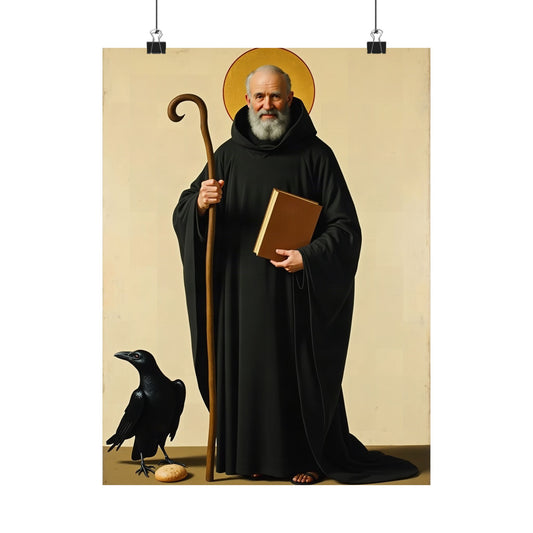
- Black habit and cowlHe usually wears the black Benedictine habit, often with the cowl pushed back onto his shoulders to show a tonsured crown, marking him as a monk.
- Abbot's crozierHe carries a staff with a curved top, which in a monastic figure signifies an abbot rather than a bishop.
- Closed bookThe book in his hand is the Holy Rule, the guide for community life that he wrote at Monte Cassino.
- Raven with a loafA raven at his side, often with a small loaf, recalls the poisoned loaf that Gregory the Great says he ordered the bird to carry away.
- Broken cup and serpentA cracked cup, sometimes with a small serpent rising from it, recalls the poisoned drink that shattered when he made the sign of the cross.
- Cross and Rule (Medal form)In the St Benedict Medal he holds a cross in his right hand and the Rule in his left, with the raven and cup below him.
- St Scholastica and the doveHis twin sister, a nun with a crozier, sometimes stands beside him with a dove, recalling Benedict's vision of her soul rising to heaven.
Names and titles
- Father of Western MonasticismHis Rule became the norm for monastic living across Europe
- Patron of EuropeProclaimed Patron of Europe by Paul VI in 1964, for the monks who followed his Rule
- The Raven and the Poisoned LoafA raven carried away a loaf sent to harm him, as told by Gregory the Great
- The Cup That ShatteredPoisoned wine in a cup that broke when he made the sign of the cross
- Keeper of the RuleHe wrote the Rule for monasteries and is shown holding it
Feast days
Feast of St Benedict, Abbot11 July, every year
The memorial of St Benedict, abbot and founder of Western monasticism, in the General Roman Calendar, which Anglicans and Lutherans also keep. The day is the old feast of the translation of his relics to Fleury. It replaced March 21 in the Roman calendar after the post-Conciliar reform.
How it's celebrated. Benedictine communities generally keep it as their principal solemnity, since it falls outside Lent. Older monastic usage added an octave, and some houses still hold it. Ampleforth Abbey marks both this day and the March transitus. Monte Cassino and Fleury have both claimed the relics, and the question is still disputed.
Sources: New Liturgical Movement: The Feast of St Benedict · Ampleforth Abbey: Feast of St Benedict · Encyclopedia.com: Benedict, St.
Transitus of St Benedict21 March, every year
The Transitus, or passing, of St Benedict, kept on the traditional date of his death, around 547. Until the 1970 reform it was his feast in the Roman calendar. Benedictines keep it as a separate observance from the July feast.
How it's celebrated. Many Benedictine monasteries still keep it, some as a full solemnity even though it falls in Lent. Others mark it more simply and give July the greater celebration. Monks recall Gregory the Great's account of Benedict dying in prayer, held upright by his brethren. They also recall the vision of a lamp-lit road to heaven.
Sources: Communio: The Transitus of Saint Benedict · Ampleforth Abbey: Fr Abbot's Homily for St Benedict's Day · Portsmouth Abbey: Transitus Sancti Benedicti
Feast of St Benedict in the Eastern Orthodox and Byzantine Catholic Churches14 March, every year
The commemoration of Venerable Benedict of Nursia, Abbot, in the Eastern Orthodox and Byzantine Catholic calendars. It honours him as a holy monastic father of the West. It is a different observance from the Western July feast and March transitus.
How it's celebrated. The day is marked in the church's calendar of saints, with hymns and a reading of his life. Churches on the traditional Julian calendar keep March 14 on what is March 27 in the civil calendar. Churches on the Revised Julian calendar keep it on the civil March 14. Little is recorded about distinctive local customs.
Sources: OCA: Lives of the Saints, Venerable Benedict of Nursia · OrthodoxWiki: Benedict of Nursia · Wikipedia: March 14 (Eastern Orthodox liturgics)
In art and place public-domain and openly licensed images


St Benedict of Nursia in the shop
-
St Benedict of Nursia: The Raven and the Poisoned Loaf — Art Print
Regular price From $29.00 USDRegular price

Sources
- Britannica: Saint Benedict of Nursia
- Wikipedia: Benedict of Nursia
- Christian Iconography: St Benedict
- Order of St Benedict: Saint Benedict
- Order of St Benedict: The Medal of Saint Benedict
- Wikipedia: Saint Benedict Medal
- Catholic Encyclopedia (Catholic Answers): Medal of Saint Benedict
- Subiaco Abbey: Work
- Stanbrook Abbey: St Scholastica
- Vatican News: Pope Leo at Montecassino Abbey
- 1911 Encyclopaedia Britannica (Wikisource): Benedict of Nursia, Saint
- Wikipedia: Cowl
- The Eastern Church: Saint Benedict of Nursia
- Wikipedia: Territorial Abbey of Monte Oliveto Maggiore
- Wikipedia: Bernardo Tolomei
- Britannica: Saint Benedict of Nursia (summary)
- Fish Eaters: Saints in Art
- SaintBenedict.com: St Benedict Medal
- Wikipedia: Monte Cassino
- Wikipedia: Rule of Saint Benedict
- Gregory the Great: Dialogues, Book II
- The Rule of St Benedict (Regula Benedicti)
Also in Christianity


← The Encyclopedia Spotted something to correct? Suggest a correction