
No. 150Folk & Fairy
Baba Yaga
Баба-Яга
Slavic forest crone of the flying mortar: tester, guardian, sometimes ogress
Baba Yaga (Баба-Яга) is the old woman of the deep forest in East Slavic fairy tales, told in Russian, Ukrainian and Belarusian and known by related names in Polish, Czech, Serbian and other Slavic folklore. She lives where the ordinary world meets the far-off tale-kingdom. Folklorists stress that she is deliberately ambiguous: a tester and donor who may help a polite, brave visitor, and sometimes an ogress who threatens to eat them. She is also described as guardian of the water of life and a rider of storms.
She lives mostly in story, in children's charms, riddles and rhymes. Since 2004 the village of Kukoboy in Yaroslavl region has been styled her homeland, with a fairy-tale museum and hut complex. Her 'birthday' is a modern festival. Some Slavic Native Faith practitioners see her as an old goddess, though scholars contest this.

How to recognise Baba Yaga
- MortarShe rides a large bowl-shaped wooden or iron mortar through the treetops, the best-known picture of her, built largely by 19th- and 20th-century artists.
- PestleA thick club-shaped pestle serves as her oar or rudder, and sometimes as a weapon.
- Birch broomA broom of birch twigs sweeps away her tracks as she flies.
- Hooked nose and fierce faceLook for an old, bony face with a long crooked nose and sharp eyes that may glow; in the tales her nose reaches the ceiling as she lies across the stove.
- Iron teeth'Baba Yaga with iron teeth' is one of her stock epithets, shown as pointed grey-metal teeth.
- Hut on chicken legsHer forest hut stands on chicken legs and turns, and a visitor must say the right words to face its door toward them.
- Skull fenceA fence of bones topped with skulls, their eye sockets glowing like lanterns, marks the edge of her home.
Names and titles
- Bony LegKostyanaya noga, one of her stock epithets in the tales
- Grandmother WitchThe usual reading of her name, though the meaning of 'Yaga' is not agreed
- Keeper of the Water of LifeBritannica describes her as guardian of the fountains of the water of life
- Turn Your Front to MeVisitors say the words that make her spinning hut face them
- Fire from the Skull LanternIn Vasilisa the Beautiful the heroine is sent to fetch fire and carries home a glowing skull
Feast days
- Baba Yaga's Birthday at Kukoboy26 June, every year
- Baba Yaga's Birthday in Russia30 June, every year
In art and place public-domain and openly licensed images


.jpg)


Baba Yaga in the shop
-
Baba Yaga · “Polite visitors welcome.” — Garment-Dyed One-Ink Tee
Regular price From $34.00 USDRegular price -
Baba Yaga · “Polite visitors welcome.” — Garment-Dyed Sweatshirt
Regular price From $52.00 USDRegular price -
Baba Yaga: Grandmother Witch — Sticker
Regular price From $4.50 USDRegular price -
Baba Yaga · “Polite visitors welcome.” — Garment-Dyed Sweatshirt
Regular price From $52.00 USDRegular price -
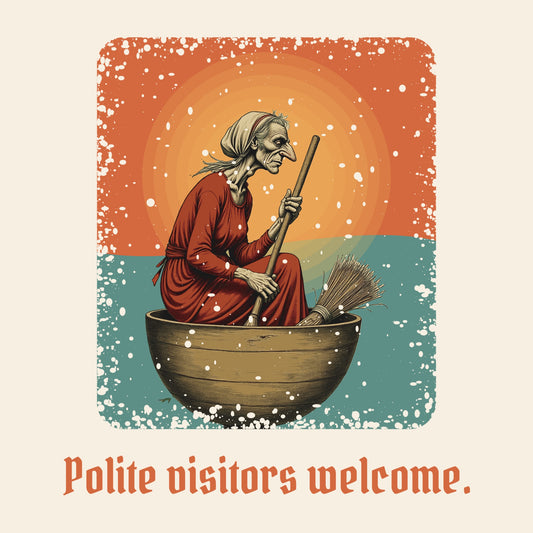
Baba Yaga · “Polite visitors welcome.” — Garment-Dyed T-Shirt
Regular price From $36.00 USDRegular price -
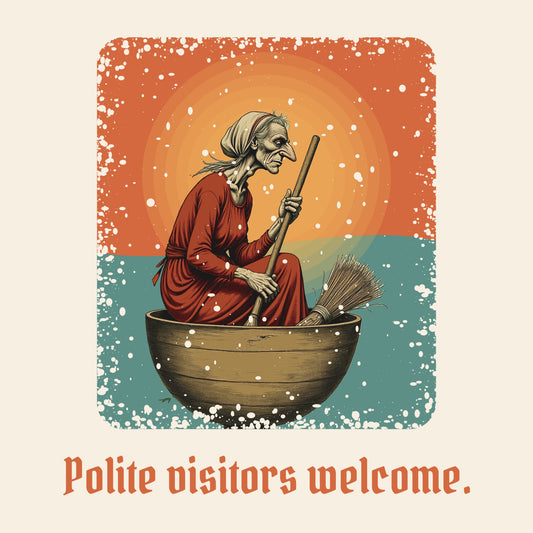
Baba Yaga · “Polite visitors welcome.” — Garment-Dyed T-Shirt
Regular price From $36.00 USDRegular price -
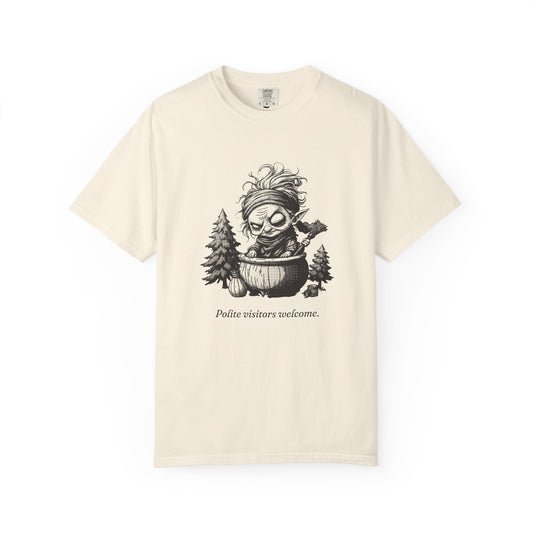
Baba Yaga · “Polite visitors welcome.” — Unisex T-Shirt
Regular price From $29.00 USDRegular price -
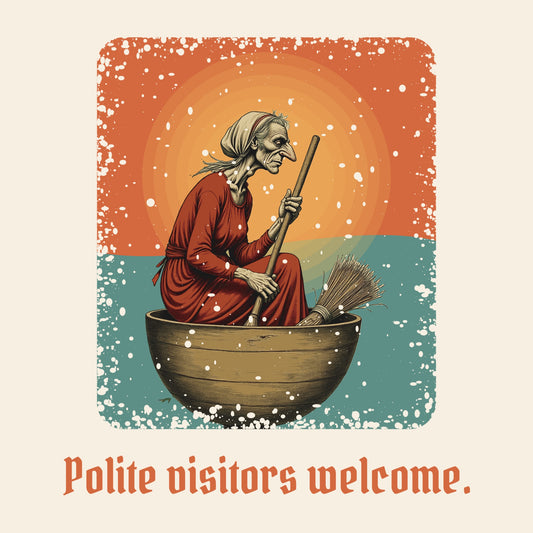
Baba Yaga · “Polite visitors welcome.” — Unisex T-Shirt
Regular price From $29.00 USDRegular price












Sources
- Britannica: Baba Yaga
- Wikipedia: Baba Yaga
- World History Encyclopedia: Baba Yaga
- Encyclopedia.com: Baba Yaga
- Gateway to Russia: Why Baba Yaga Flies in a Giant Mortar
- Wikipedia: Vasilisa the Beautiful
- Wikisource: Author Ivan Bilibin
- Wikipedia: Ivan Bilibin
- Tulane University Exhibits: Ivan Bilibin and Fairy Tales
- University of Florida Extension: Baba Yaga informational material
- Houston Symphony: Mussorgsky's Pictures at an Exhibition
- St Moroky: Hartmann's Pictures
- Russian Wikipedia: Кукобой
- DAN News: Baba Yaga's Birthday
- Lenta.ru (2005): Baba Yaga news
- Visit Yaroslavia: Kukoboy
- Springer: book chapter on Baba Yaga
- American Literature: Baba Yaga and Vasilisa the Beautiful
- FAIR: Baba Yaga in Slavic Folklore
- Metropolitan Museum of Art: collection object 346087
- Andreas Johns, Baba Yaga: The Ambiguous Mother and Witch of the Russian Folktale (Peter Lang, 2004)
- Vladimir Propp, Morphology of the Folktale (University of Texas Press, 2000 ed.)
Also in Folk & Fairy


← The Encyclopedia Spotted something to correct? Suggest a correction